A
() , . , , . . , , , . () ’ ; . ." , . , . () . , . . ’ , . , . () , . ’ , . , : , , .
Reading Guide
Section 4 of 9
Section
The Passage Reader
① The passage reader is the heart of the Reading module — every word and sentence is interactive. ② Top sticky bar: live word count, scroll progress, and live WPM (words-per-minute) calculated from when you opened the passage. ③ Exam-mode passages add a global countdown timer. When time runs out the comprehension quiz auto-submits with whatever answers you have. ④ The Reader Settings menu (top-right gear) lets you tune font size, line height, and contrast for comfort. ⑤ Translation toggle — when you have a target language set in your profile, you can flip the entire passage into your native language paragraph-by-paragraph for hard sections. ⑥ Two tabs at the top: Passage (the text + key vocabulary panel) and Questions (the comprehension quiz + post-quiz feedback). Both stay mounted so your quiz answers persist when you switch back. ⑦ Bookmark icon at the top — saves the passage to "Saved for later". ⑧ Export PDF button — downloads a clean printable copy with vocabulary list. ⑨ Tip: do one full read first, then open Questions. Resist the urge to ping-pong between text and quiz — exam strategy improves much faster when you commit to one full read.
Translation in English will appear here...
Tap any word for its meaning · select a phrase to highlight it.Key vocab highlighted
() , . , , . . , , , . () ’ ; . ." , . , . () . , . . ’ , . , . () , . ’ , . , : , , .
To take apart or destroy something gradually and systematically.
برچیدن، متلاشی کردن
"However, in a small workshop in Mainz, Germany, a goldsmith named Johannes Gutenberg was quietly developing a machine that would dismantle this information monopoly forever."
In a way that shows a lot of care, effort, and attention to detail.
با زحمت زیاد، با دقت فراوان
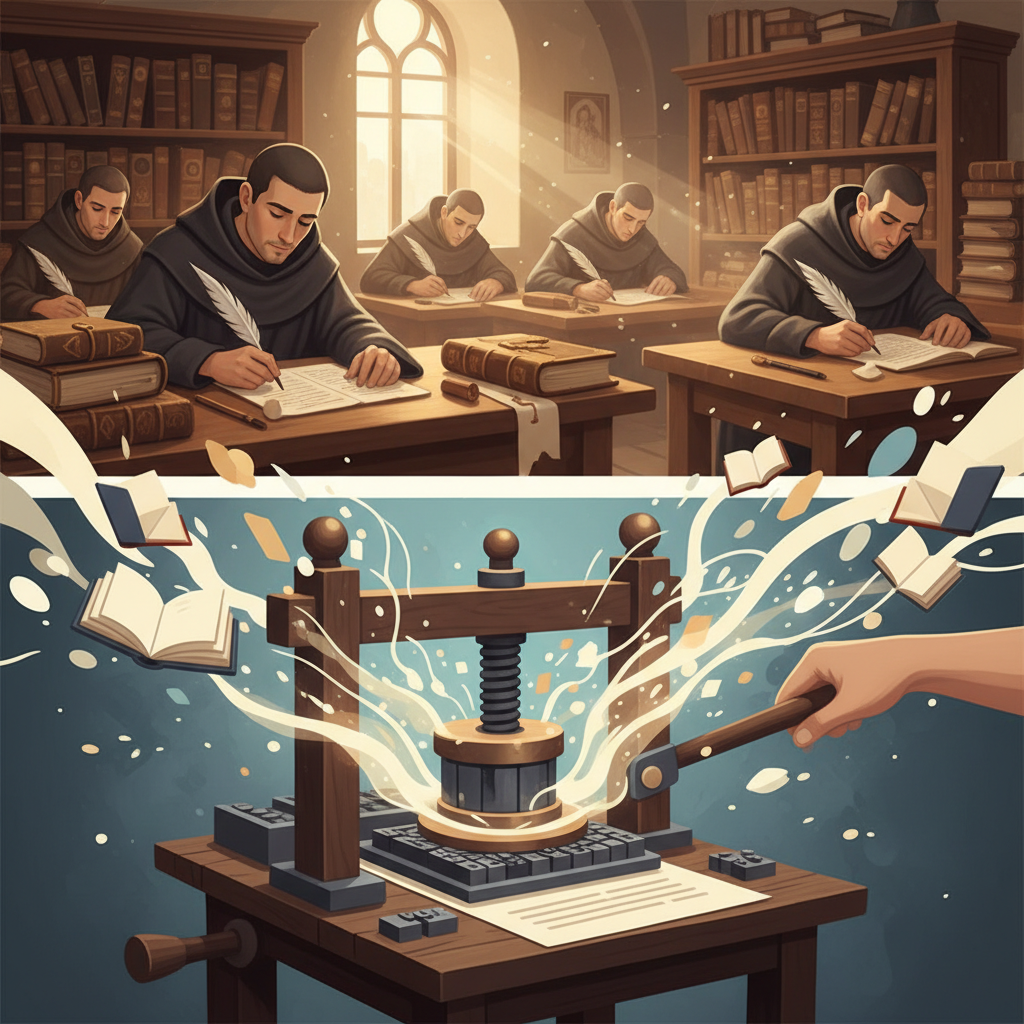
"For centuries, books were luxury items, painstakingly copied by hand by monks in silent scriptoriums."
Having a very great or intense influence, effect, or meaning.
عمیق، ژرف
"The impact was immediate and profound."
Made something accessible to everyone, rather than just a privileged group.
در دسترس همگان قرار دادن
"Just as Gutenberg’s press democratized the written word, the internet has democratized data."
Very close to a point where a new situation, often a significant one, is about to begin.
در آستانه
"In the mid-15th century, Europe was on the brink of a revolution that had nothing to do with swords or crowns."
The process of increasing in speed, strength, or development over time.
شتاب گرفتن، قوت گرفتن
"Similarly, the scientific revolution gained momentum because researchers could share their findings accurately without worrying about a scribe making errors during the copying process."
Complete control of the supply of or trade in a commodity or service.
انحصار
"However, in a small workshop in Mainz, Germany, a goldsmith named Johannes Gutenberg was quietly developing a machine that would dismantle this information monopoly forever."
To reduce something, such as costs or prices, by a large amount.
به شدت کاهش دادن
"This efficiency slashed the cost of books, making them accessible to the emerging middle class."
An important discovery or event that helps to improve a situation or provide an answer.
پیشرفت بزرگ، کشف مهم
"His most significant breakthrough, however, was "movable type.""
To begin to fail, weaken, or come to an end.
فرو ریختن، تضعیف شدن
"As literacy rates climbed, the control that religious and political authorities held over information began to crumble."
Ready to test your comprehension?
What was the primary reason that books were considered luxury items before the 15th century?
How did Gutenberg create his printing press?
Scientific progress was aided by the printing press because it ensured that research could be shared without human copying errors.
What can be inferred about the work of scribes before the printing press based on the text?
What is the closest meaning to the word 'dismantle' as used in Paragraph A?
According to the final paragraph, what do the printing press and the internet have in common?
0 words looked up